


After a fantastic opening with the crème de la crème of the film industry and the official opening movie ‘ORAH’ as seen on social media as I didn’t attend that cinematic experience, day two of the African Film Festival (AFRIFF), proved to be a promising spot for knowledge on the ways of the industry, screening of some of the creative works and sessions that help address some of the issues facing the Nigerian film industry.
While the second day of this festival brought a captivating mix of films, each a testament to the artistry and storytelling prowess of filmmakers from all corners of the globe. The festival was marred with some problems that I cannot help but address.
The day commenced with the session on policy and financing. It featured the Governor of Lagos States Jide Sanwo-Olu(who has been very supportive of the industry), the Chairman of Access Holdings, Herbert Wigwe, Chris Oshafi of PAC Capital and Eric Monchu Intong of Afrexim. Unfortunately, this was a session I had to miss as the event venue was changed but what was okay about this session was the fact that I was aware of this change.
When I got to the venue for the second session, I was told that had changed as well. So off I went to the new venue and joined the session moderated by BB Sasore and had Kayode Kasum, Kenneth Gyang and Abba Makama as panelists. Some of the key highlights I enjoyed from the session:
“Creatives don’t need to source for money from all financiers, especially if there is no alignment creatively” Kayode Kasum
“You need to study, do research as an artist, you don’t need to copy” Kenneth Gyang
“There are various labs looking for scriptwriters, visit YouTube, watch videos on writing a script and then apply” Abba Makama
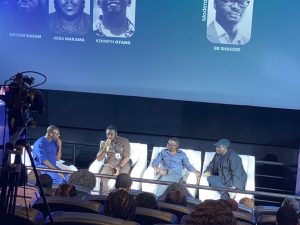
Both Sasore and Gyang mentioned their movies screen during the festival – “Breathe of Life” and “This Is Lagos” respectively! While Abba Makama’s “Lost Okoroshi” will be streaming on Apple TV.
While taking a break, having a meal, I decided to see one of the productions screening and happened to bump into “This Your Lagos”! At first, I thought it was Kenneth Gyang’s production, turns out it was a documentary about a man, a white man living/engaging with 3 different people in Lagos. An entrepreneur, Siji Motors, a worker called Grace and abgeros in Oshodi market.
The documentary aimed to shed light on a social issue, leaving viewers both informed and entertained on the lengths this ‘oyibo’ will go to carry out this social experiment. Some found it, entertaining, I found it noisy. The sound quality was bad, loud, and noisy. I can expect it from the scenes at Oshodi but for the others, it was very distracting. The social experiment is a welcome/creative one, unfortunately again, I didn’t wait till the end as I had a session to attend.
The festival took another turn in the evening as I had to leave the Landmark venue as all sessions had been moved back to Sol Beach. I must hand it to them though, construction must have started that very day or late the night before and while the place was set, it was so hot! Lights where in our faces, making images of the panellists blurry and the microphones didn’t work.
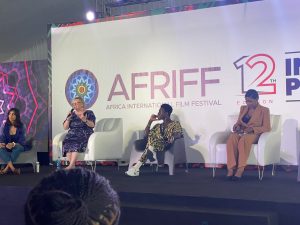
The session focused on support, labs, grants, and fellowships. While they discussed how Nigerians and Africans in general can access assistance, funds, and platforms of US Mission NG, NEFTI, La Fabrique Cinema by Institut Francais, Kwazulu Natal Film Commission and Cite International Des Arts it felt limiting as the steps and accessibility wasn’t as clear or detailed to the me the listener.
As the curtains drew on Day Two, the excitement from some of the participants were palpable, friends and colleagues from before networking and shaking hands. If the issues of Day 2 linger into Day 3, and the rest of the week, then the AFRIFF has just managed to be one full of fluff, aesthetical fluff for that matter. I offer my appreciation to the filmmakers for their dedication to presenting their films maybe just maybe, they would offer me the unforgettable memories and experience I crave.
